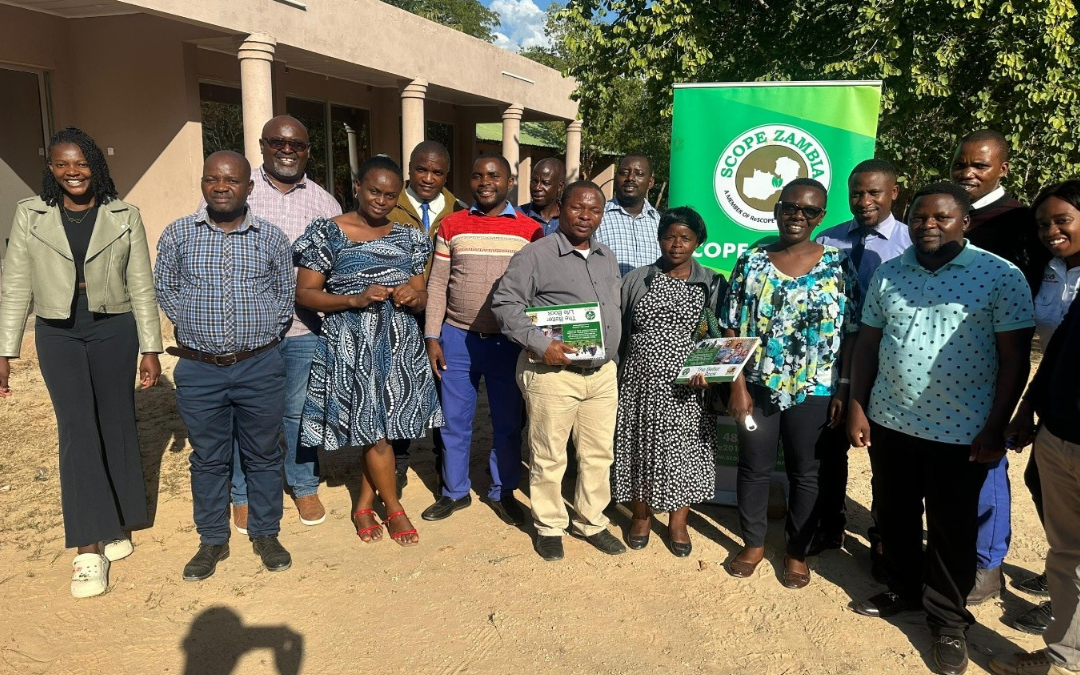
Strengthening Sustainable Communities Through Permaculture: SCOPE Zambia Launches Bread
for the World Project in Solwezi
Solwezi, May 2025
SCOPE Zambia successfully launched its latest initiative under the Bread for the World project in
Solwezi District. During the two-day workshop, teachers, community members, and education officials
gathered to build capacity in permaculture and agroecology, laying the groundwork for long-term
transformation in five selected schools and their surrounding communities.
SCOPE Zambia recently expanded its work to North-Western Province. As part of this effort, a baseline
survey was conducted across five selected schools in Solwezi District to better understand the current
conditions, opportunities, and challenges, the schools are facing within each. These assessments are
crucial for tailoring intitiatives to the needs of the communities in order to fully exploit the potential, the
schools hold. The Bread for the World project focuses primarily on the establishment of food forests—a
resilient, sustainable systems intended to serve as an additional source of fruits and vegetables for
learners. This initiative aims to improve nutrition and promote a balanced diet among pupils, while also
building environmental awareness and resilience.
Day One: Community Sensitization
The program started on 7th May with a meeting at Solwezi Urban Primary School, where SCOPE
Zambia staff met with the District Education Board Secretary (DEBS) and Mr. Kandela, the DEBS Office
Planner. In collaboration with Mr. Kandela, two community members were selected from each of the
five schools: Kazhiba Primary, Kapijimpanga Secondary, Kimiteto Secondary, Kyatobo Primary, and St.
Francis Secondary.
Community participation is central to the program’s success, especially given the transient nature of
teaching staff. The presence of nine community members representing four of the five schools was a
strong start.
Following opening remarks by the DEBS and SCOPE Zambia’s National Coordinator, Henry Chibutu
introduced the concept of permaculture, its principles, and its relevance to the Bread for the World
project.
An agroforestry expert explained the benefits of tree planting and the practical steps involved in
establishing a tree nursery. To pinpoint expectations and the potential, participants created community
maps and identified five priority elements they want to establish in their communities, such as access
to clean water, construction of local markets, oil processing machines and hammer mills. The
establishment of plantations was also an often suggested request to work against the deforestation
caused by charcoal production.
Afterwards, Community members were introduced into the responsibilities and tasks of becoming
facilitators and given a brief overview of monitoring and evaluation practices.
The day concluded with a baseline survey at Kazhiba Primary School, where staff demonstrated strong
commitment to agricultural education and openness to organic practices. A planned second school
visit was unfortunately cut short due to the school being on break.
Day two: teacher training and capacity building
The second day focused on training teachers from the five selected schools, with two representatives
per institution. After the DEBS formally opened the session, Henry Chibutu reintroduced the principles
of permaculture and the goals of the Bread for the World project.
Tukiya followed with an insightful presentation on agroecology, its advantages, and best practices. The
teachers engaged enthusiastically, sharing their existing knowledge and debating strategies such as
companion planting. Many already had agricultural expertise, and their contributions enriched the
training.
A session on Integrated Land Use Design (ILUD), a particular permaculture approach, which deals with
the chronological implementation of organic agriculture, was led by Henry Chibutu and followed by a
dicussion about the Importance and Challenges of the Utilization of Indigenous seeds.
After lunch, an expert presented the economical and ecological advantages of establishing food
forests, which also includes the improvement of the soil and the creation of wildlife habitats. This was
followed by group discussions concerning, tree nurseries and techniques such as bedding and
grafting.
To ensure student involvement, Henry Chibutu led a final session on forming school-based
permaculture clubs. These clubs will play a critical role in sustaining the project, empowering youths
and raising awareness about sustainable agriculture. Teachers were then asked to complete a baseline
questionnaire, helping to gather valuable data on the current status and needs of each school.
Experts from a diverse range of fields, participated and enriched the workshop by sharing their
knowledge and advising on key topics. Engaged teachers and community members not only
contributed to the program but also played key roles in determining clear objectives. Their openness,
knowledge and enthusiasm was inspiring.
Engaging both teachers and community members, often proved to be a strong strategy, not only
ensuring long-term success but also increasing the visibility of the project. With enthusiams, schools as
well as communities showed great interest in deepening the collaboration and advancing our mission.
The program not only built capacity but also collected essential insights into the challenges and
opportunities, whereby our activity was launched successfully.
We are really looking forward to a good cooperation!
Strengthening Sustainable Communities Through Permaculture: SCOPE Zambia Launches Bread for the World Project in Solwezi